
The Liar's Dividend
The ongoing erosion of truth

Welcome. I’m glad you’re here.
This newsletter covers what the World Economic Forum calls one of the world’s biggest problems. Disinformation — deliberately manufactured and distributed lies with the goal of fooling you for the financial, political or personal benefit of someone else — is much more than politics. Its tentacles seep into every nook and cranny of our society. You are bombarded with disinformation every day — it can impact your money, your job, your belief system — and you might not even know it. And it’s getting worse.
I’m Paul Brandus, an independent, Washington, D.C.-based journalist. I work for no one, am intimidated by no one, and cover this issue with neither fear nor favor. Here’s my LinkedIn bio if you want to know more. I hope you’ll support my work by subscribing — and sharing this with others. Thank you.
#####
Trump Spreads More Disinformation About 2020
In 1984, George Orwell wrote that repeating lies over and over again effectively rewrites history and alters perception. The lies pass into collective history and become "truth". This makes independent thought obsolete, as the lie becomes indistinguishable from objective reality.
This is particularly true in our age of post-reading and post-literacy, and when some citizens are 1) inclined to trust the messenger and 2) not read or think critically on their own. If I’m portraying such people as low-information citizens, well, that’s what they are.
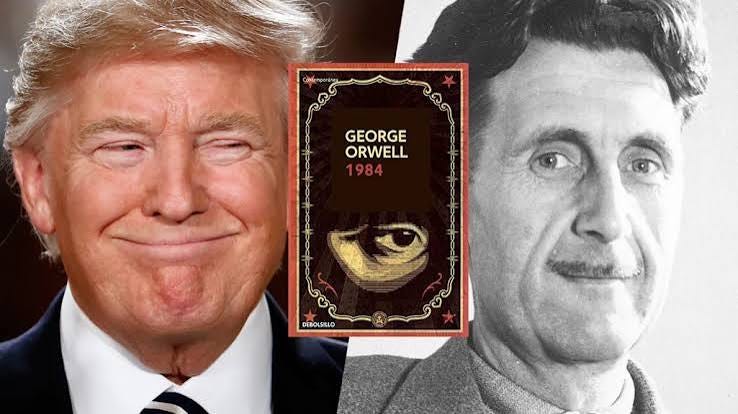
“In the end the Party would announce that two and two made five, and you would have to believe it. It was inevitable that they should make that claim sooner or later: the logic of their position demanded it…” —from 1984 by George Orwell
He claimed that newly declassified documents reveal intelligence agencies hid Chinese interference and that China obtained voting data on 220 million Americans (pro-Trump media, like Fox, immediately said that Trump “uncovered” or “revealed” this, but real journalists, who are supposed to be skeptical and questioning of authority, said, correctly, that Trump merely made an allegation).
He declared the 2020 election was “left vulnerable to being rigged and stolen.”
As usual, the lies spread quickly, shared on social media by followers eager to believe—to quote Orwell again—that 2+2 = 5. Data from NewsGuard:
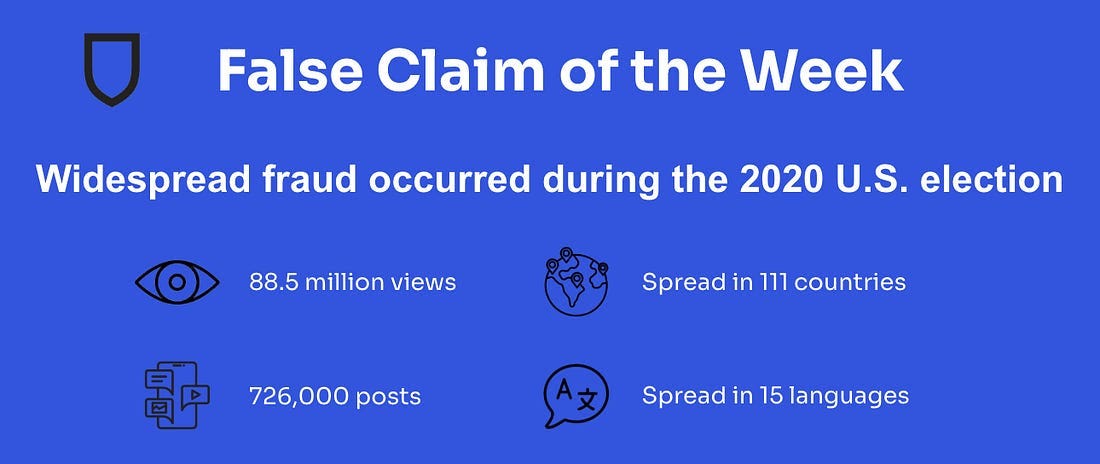
The amount of spread on X from the seven-day period July 14, 2026, to July 20, 2026 (via NewsGuard)
Once again, here is what the president and his followers refuse to acknowledge let alone believe:
The 2020 election was secure: Bipartisan election officials in all 50 states, along with dozens of court rulings and federal reviews, verified the 2020 election results.
Documents disprove widespread fraud: A newly declassified January 2020 National Intelligence Council memo (when Trump was president) explicitly noted that vote tabulation systems were “difficult to manipulate on a wide enough scale” due to paper trails and offline systems.
Public voter data isn’t a breach: Experts point out that voter registration lists are public information that can be legally purchased—possessing them does not mean election systems were hacked.
The big picture: While false election narratives have persisted on social media since late 2020, direct promotion from the White House provides unprecedented visibility and momentum to debunked theories.
#####
The Biggest Threat from Disinformation Isn’t the Lie — it’s the Erosion of Truth
A new paper in Trends in Cognitive Sciences argues that the most dangerous impact of mis- and disinformation isn’t just getting people to believe specific lies—it’s destroying our shared agreement on how to determine what is true.
Key findings:
False narratives shape memory, beliefs, and behavior about everything from vaccines, climate, elections and more.
Social media has turned narrative-building into a participatory, algorithm-driven process. Influencers co-create “realities” with followers, and outrage/divisive content gets rewarded by engagement-based ranking.
Generative AI adds a new layer: models fabricate content confidently, can be fine-tuned to push narratives, and personalize persuasion to individual biases — all while people struggle to resist AI-generated misinformation even when warned.
The real danger: flooding info ecosystems with half-truths and confusion doesn’t just create false beliefs — it teaches people that truth itself is unknowable. That’s the “liar’s dividend” and truth relativism at work.
Elites are shifting from evidence-based “fact speaking” to sincerity-based “belief speaking” — a rhetorical move that’s spreading and normalizing epistemic relativism in public discourse.
What’s next
Fixing the problem requires a multi-layered defense spanning both individual tools and platform-level reforms:
Individual interventions: Prebunking (inoculation), media literacy, and AI-assisted fact-checking.
Systemic fixes: Algorithmic transparency, demonetization of bad actors, and platform interoperability.
Go deeper: Read the full study in Trends in Cognitive Sciences or explore systemic policy recommendations in the latest European Commission report.
#####
The Misinformation Lifespan Myth
What’s happening: The myth that all online misinformation behaves the same way over time is being busted. New research from the Time-Horizon Geometric Engagement Effectiveness (TH-GEE) framework confirms that narratives—both false and factual—follow many different lifespans. The force behind the study is cognitive warfare and computational social scientist Bonnie Rushing. Her observations:
How it works: TH-GEE analyzes three distinct aspects of how a narrative captures attention:
Persistence: Constant attention over the long term. (e.g., Flat Earth conspiracy, Covid vaccines).
Recency: Continued attention in the present moment.
Re-emergence: Attention returning after a quiet, dormant period. (e.g., Moon-landing hoax claims).
Why it matters: The same engagement patterns seen in debunked theories (acute, persistent, or recurring) also appear in benign topics like sports and education. This means unusual behavior alone cannot prove a claim is false or coordinated.
The takeaway: Stop using a “temporal signature” as a shortcut to identify misinformation. Instead, use these patterns to measure what an already-identified false narrative is doing. This allows analysts to better prioritize responses, predict shifts in attention, and avoid confusing “loud” narratives with “manipulated” ones.
Thank you, Bonnie Rushing, for your terrific work.
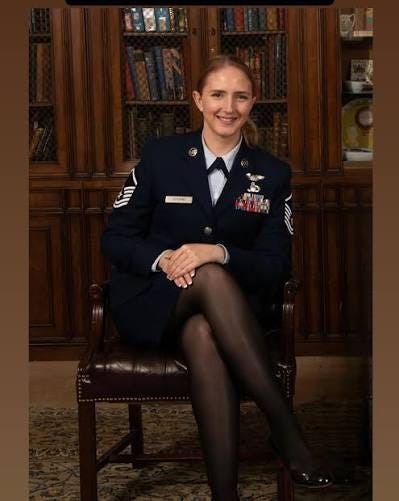
Bonnie Rushing
#####
You’ve heard of SEO — Search Engine Optimization. Now there’s AEO — Answer Engine Optimization
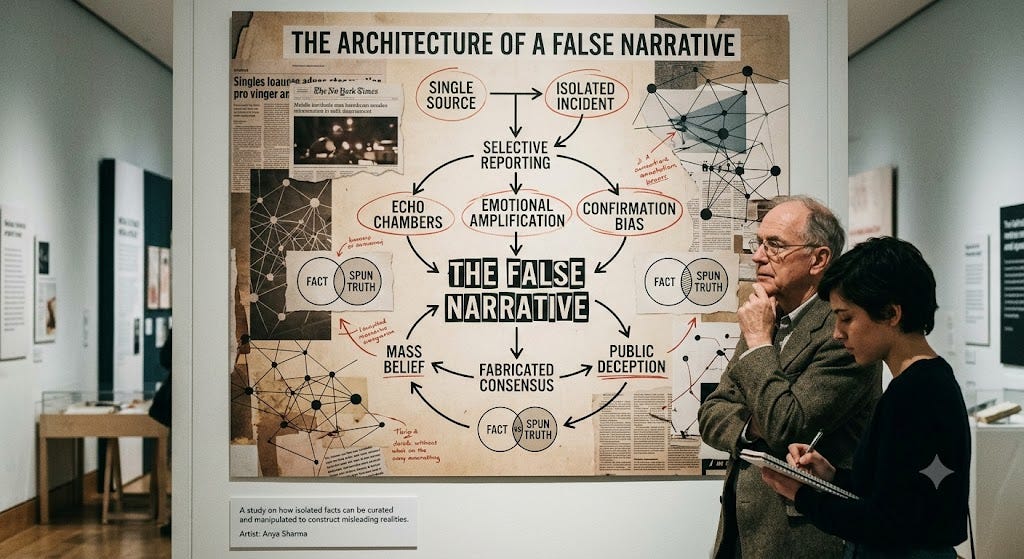
As search migrates to AI, keep in mind that Large-Language Models (LLMs) that AI uses to provide answers are based on what can be scraped off the internet. That’s a double-edged sword of course, because bad actors can plant disinformation online, knowing that it could pop up in a later AI prompt. Garbage in, garbage out, this dynamic is called. But it could also be used to shape narratives in a more positive way, a possible boon to companies and individuals looking to manage their online reputations and counter possible false narratives. The New York Times takes a deeper dive and it’s worth a few minutes of your time.
#####
CBS’s O’Donnell Takes on Health/Medical Disinformation
CBS News’s Norah O’Donnell is putting women’s health in the spotlight with a new podcast that she says will cut through misinformation. It’s called “Healthful” and it debuts today.

“Every week I want to bring you the latest science and trusted medical expertise,” O’Donnell says. The show will feature conversations with doctors and researchers on topics including menopause, reproductive health, cancer, the gut microbiome and women’s sexual health.
“Our goal is simple … to deliver fact-based information that you can trust,” she says.
O’Donnell tells Women’s Health magazine that the podcast is designed to answer the questions many women struggle to navigate amid an overload of conflicting medical advice.
“I’m introducing women to the world’s leading experts on all these things that we want to know more about at a time where we have all this access to information, and yet many of us are more confused than ever,” she said.
#####
Stat of the Week
A lawyer friend of mine here in Washington has a series of lunches for his interns each summer and invites assorted people to attend. At my lunch with them, I asked them if they could tell deepfakes from real images. One kid, 18, said he could, that he had a good feel for what was real and what was fake. Which brings me to this week’s statistic, courtesy of the World Economic Forum in Davos:
In controlled media detection testing, only 0.1% of people could reliably spot AI-generated deepfakes across all media formats (text, audio, image, and video).
Beware of your self-perceived ability to know the difference between fact and fiction.
#####
Quote of the Week
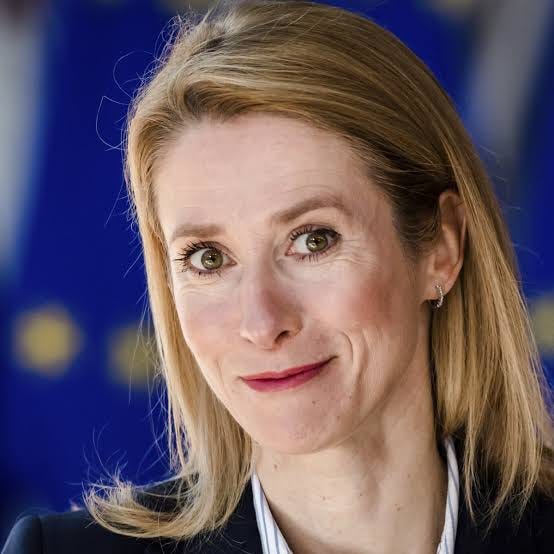
“If we cannot tell what is true and what is not, we are easily manipulated. Foreign Information Manipulation and Interference is death to democracy by a thousand cuts.”
— Kaja Kallas, EU High Representative for Foreign Affairs and Security Policy, addressing the 2026 Conference on Countering Foreign Information Manipulation.
#####
Upcoming Events and Conferences
EDMO BELUX 2.0 Final Conference
When: September 8, 2026
Where: Brussels, Belgium
Focus: Hosted by the European Digital Media Observatory (EDMO) network, this summit centers on “Countering disinformation, raising democratic resilience” with a deep dive into fact-checking infrastructures across Europe.
#Disinfo2026 (EU DisinfoLab Annual Conference)
When: October 7–8, 2026
Where: Vilnius, Lithuania
Focus: A premier gathering for the counter-disinformation community. The 2026 focus targets “enforcement and evidence”—exploring platform legal accountability, the enforcement of the Digital Services Act (DSA), and OSINT investigative strategies.
DSI Digital Publics Conference
Dates: October 21–23, 2026 | Location: Zurich, Switzerland
Focus: The inaugural conference hosted by the Digital Society Initiative (DSI) community, bridging academic research with tech policy to look at how misinformation impacts public discourse.
Looking Ahead to 2027
The 2027 Cambridge Disinformation Summit
Dates: March 23 to March 25, 2027 | Location: Cambridge University
Focus: The three-day event will explore the incentives and power infrastructures that drive disinformation, framing intentional deception as a preparatory act for corruption and exploitation.
International Conference on Fake News, Social Media Manipulation and Misinformation (ICFNSMMM)
Dates: April 8–9, 2027 | Location: Athens, Greece
Focus: An academic forum organized by WASET serving as an interdisciplinary platform for empirical studies, network analysis, and AI-driven fake news detection methodologies. (A secondary session is slated for August 19–20, 2027, in London).
A Note on Attendance: For practitioner-focused events like
#Disinfo2026, registrations are actively vetted on an individual basis due to capacity constraints. If you plan to attend or submit a proposal, early application via their official portals is highly recommended.
#####
Thank you — I want to hear from you
Information integrity is such a huge and vital topic. I want to hear what you think. Here’s my email: DisinformationWire@yahoo.com. Tell me your stories, share your thoughts, send me tips, questions and ideas. I can’t promise that I’ll be able to respond to every email, but I do read each and every one. If you are not a subscriber, I hope you’ll become one. Paid subscribers get my same-day personal response. I’m very appreciative of your interest in this important subject. Thank you.
Paul Brandus / Washington, July 22, 2026
#####